
DRAM Shortage Until 2030: What It Means for Hardware Buyers
The global DRAM shortage is expected to continue until 2030, driven by rapidly increasing demand from artificial intelligence (AI) applications.
According to Chey Tae-won of SK Hynix, the supply of DRAM is struggling to keep up with the growing needs of AI infrastructure, especially from companies such as NVIDIA.
This shift is already having a direct impact on embedded hardware pricing, component availability, and long-term supply planning.
How AI Is Reshaping the Hardware Supply Chain
AI workloads require high-performance GPUs, which in turn depend on high-bandwidth memory (HBM). The production of HBM consumes significant DRAM resources.
As a result:
- DRAM supply is increasingly allocated to AI infrastructure
- Traditional embedded and commercial hardware face supply pressure
- Component pricing is becoming more volatile
For hardware buyers, this means that what used to be a stable bill of materials (BOM) is now subject to frequent changes.
A Long-Term Structural Shift, Not a Short-Term Issue
Unlike previous supply fluctuations, this is not a temporary disruption.
Expanding DRAM production capacity requires significant time due to constraints such as energy supply, water resources, and manufacturing ecosystem readiness.
Industry leaders estimate that it may take 4–5 years to meaningfully increase capacity.
As a result, hardware buyers should prepare for a long-term shift in pricing and supply conditions.
Impact Across Embedded and Smart Device Applications
This trend is affecting a wide range of applications, including:
Smart retail systems
Interactive kiosks
Industrial control panels
Smart home control interfaces
Digital signage and commercial displays
Companies developing these solutions must now balance performance requirements with supply chain stability.
The Most Common Mistake in Hardware Selection
In response to supply uncertainty, many buyers assume that choosing the highest-performance platform is the safest approach.
However, this often leads to:
- Higher system costs
- Longer lead times
- Over-specified hardware that exceeds actual requirements
In many cases, this strategy increases risk rather than reducing it.
Choosing the Right Platform: Performance vs. Stability
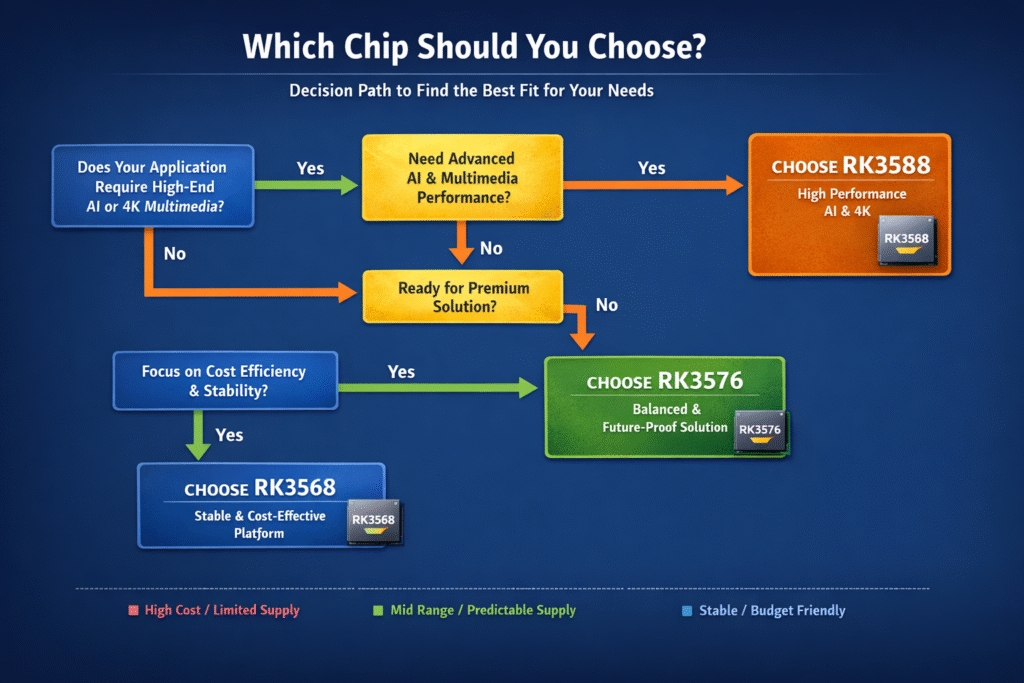
For many applications, mid-range platforms already provide sufficient performance.
Solutions based on Rockchip RK3568 and Rockchip RK3576 can support:
- Touch-based user interfaces
- Cloud connectivity
- Multimedia playback
- Peripheral device integration
While these platforms are also affected by market changes, they typically offer:
- More stable supply
- Moderate cost increases
- Better long-term availability
In contrast, high-performance platforms such as Rockchip RK3588 may face greater supply pressure due to their relevance in AI-related applications.
How to Select the Right Hardware Platform in 2026 and Beyond
To make a more resilient hardware decision, consider the following:
- Does the application require high-performance AI processing locally?
- Can the system operate efficiently on a mid-range platform?
- Is long-term supply stability more critical than peak performance?
Choosing the right platform is no longer just a technical decision — it is a supply chain strategy.
Conclusion
The ongoing DRAM shortage is reshaping the embedded hardware landscape.
Rather than focusing solely on performance, companies must now consider cost stability, supply continuity, and long-term scalability.
Selecting the appropriate platform based on actual application needs will be key to maintaining competitiveness in the coming years.
Contact Us
If you are planning an embedded hardware or smart device project, we can help you evaluate the most suitable platform based on your application and supply chain requirements.
Feel free to contact us to discuss your project.