
RK3568 vs RK3576 vs RK3588: A Practical Comparison for Embedded Systems
Choosing the right processor is one of the most critical decisions in embedded hardware design.
With ongoing supply chain changes and rising component costs, selecting between Rockchip RK3568, Rockchip RK3576, and Rockchip RK3588 is no longer just about performance — it’s about balancing cost, availability, and long-term stability.
This guide provides a practical comparison to help you make the right decision.
1. Overview of the Three Platforms
RK3568 — Stable and Cost-Effective
- Mature platform with wide adoption
- Optimized for long lifecycle projects
- Suitable for most standard embedded applications
👉 Best known for: stability and affordability
RK3576 — Balanced Performance and Scalability
- Newer-generation processor
- Improved performance over RK3568
- Better suited for more demanding UI and system workloads
👉 Best known for: balance and future-proofing
RK3588 — High Performance for Advanced Applications
- Flagship-level performance
- Strong GPU and AI capabilities
- Designed for high-end computing scenarios
👉 Best known for: maximum performance
2. Performance Comparison
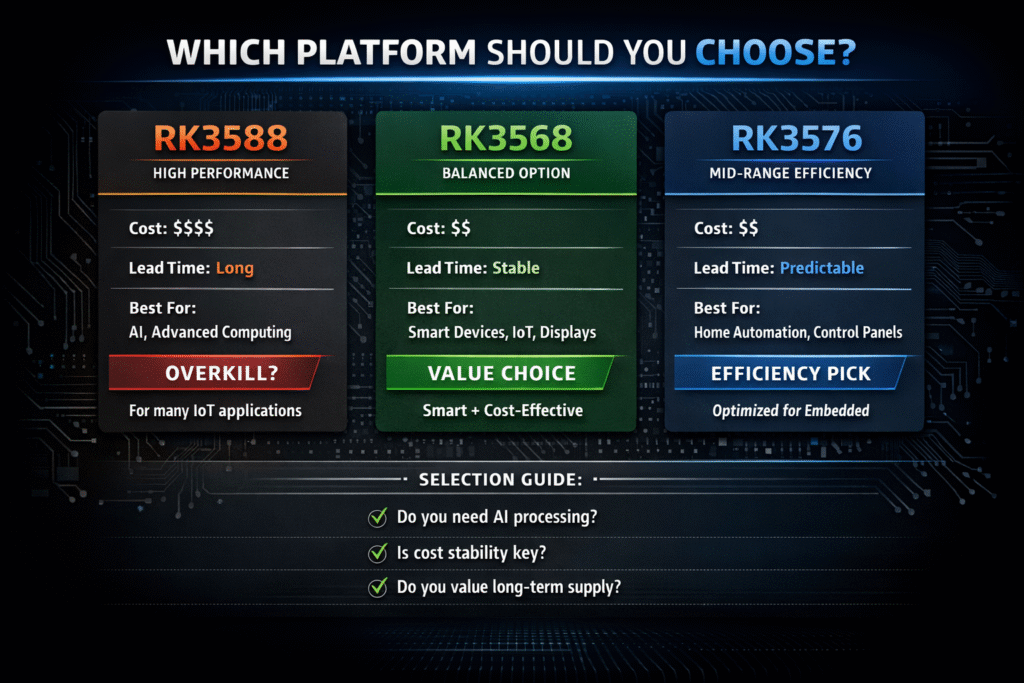
From a pure performance perspective:
RK3588 > RK3576 > RK3568
However, performance alone should not determine your choice.
In many embedded scenarios, mid-range platforms already meet system requirements without the added cost and complexity of high-end solutions.
3. Supply Stability and Market Availability
In the current market environment, supply conditions differ significantly:
RK3568
→ Highly stable, widely available
RK3576
→ Increasing availability, improving supply
RK3588
→ More constrained due to demand from AI-related applications
This makes supply stability a key factor in platform selection.
4. Pricing Trends and Cost Considerations
Due to global DRAM and component supply pressure:
RK3588
→ Higher cost, more volatile pricing
RK3576
→ Moderate pricing, relatively controlled increases
RK3568
→ Most cost-effective and predictable
For projects with tight budgets or large-scale deployment, cost stability becomes critical.
5. Typical Application Scenarios
RK3568 is suitable for:
- Smart control panels
- Basic interactive displays
- Industrial HMI systems
- Entry-level digital signage
RK3576 is suitable for:
- Advanced interactive displays
- Smart retail and service terminals
- Multi-functional embedded systems
- Applications requiring smoother UI and scalability
RK3588 is suitable for:
- AI-based applications
- Advanced multimedia processing (4K/8K)
- Edge computing with heavy workloads
- Vision-based or GPU-intensive systems
6. The Most Important Insight: Avoid Over-Specification
One of the most common mistakes in hardware design today is over-specifying the platform.
Choosing a higher-performance processor than necessary can lead to:
- Increased system cost
- Longer procurement cycles
- Higher supply chain risk
In most cases:
A well-optimized mid-range platform delivers better overall project value than a high-end solution.
7. How to Choose the Right Platform
When selecting between RK3568, RK3576, and RK3588, consider the following:
Choose RK3568 if:
- Cost control is a priority
- Your application is stable and well-defined
- Long-term availability is critical
Choose RK3576 if:
- You need a balance of performance and cost
- Your system requires smoother UI or more processing headroom
- You want a future-ready platform
Choose RK3588 if:
- Your application requires AI or high-end computing
- Performance is the top priority
- Budget and supply risk are manageable
Conclusion
There is no single “best” processor — only the most suitable one for your specific application.
In today’s environment, the smartest choice is not the most powerful platform, but the one that balances:
- Performance
- Cost
- Supply stability
Careful platform selection can significantly reduce project risk and improve long-term scalability.
Not sure which platform fits your project?
Share your application with us — we can suggest the most cost-effective and stable solution.